About

Issue #129
From global action, local motion: Harsha Walia seeks justice for Vancouver newcomers

MT @kellebelleca: The 100 Block doc on survival #sexwork in the #DTES Jun 12@7:30pm! $10 proceeds to @WISHWellness http://t.co/j7bildNiF0 May 19, 09:24 PM

One last walk with Judy Graves: City of Vancouver’s only full-time advocate for the homeless to retire in May


Photos by Christine McAvoy. 


It’s one of the first sunny days of spring, and the herons have returned to their rookery in Vancouver’s Stanley Park. Judy Graves walks slowly, pausing to admire the wiry herons’ nests, the new daffodils and the fluffy cherry blossoms. The 63-year-old’s nails are whimsically painted a lilac pastel that matches her goofy spontaneity and youthful inquisitiveness. “Here,” she says, leading us towards the Vancouver Park Board’s headquarters. We follow her to a side of the building thick with rhododendron bushes. “When I’m a homeless old woman, this is where I’ll live.”


It takes a moment to understand what she means. She points to a rectangular covered area with a clean white concrete floor. Short walls provide some shelter from the elements. “The people who live here are usually very organized,” she says. “One man, he would cook his food out on the beach. And he just loved the flowers.” The space, so small and hidden by the wall of flowers, is easy to miss. 


But to Graves, it’s one of countless spaces hidden in plain sight that are home to the city’s homeless. They are places and people she knows well. She has spent more than half her lifetime working with Vancouver’s homeless and hard-tohouse, and holds the City of Vancouver’s only position as an advocate for the homeless. It’s a title she’s held since 2010. It evolved from her work through the 1980s, ‘90s and the first decade of the 2000s as the city’s tenant assistance coordinator. 


Now, her days with the city are drawing to a close. She turns 64 on Wednesday, May 29, a day that will also mark her retirement from a career that has spanned over three decades. In much the same way she’s approached other aspects of her life, she decided in January to leave, she says, because it simply felt right. She’s not aware of any plans to replace her. 


Graves isn’t the type to self-aggrandize, but she believes her position should be filled. “I think it’s important to have an informed advocate within the system who can speak truth to power. It's very easy for government to start believing its own spin,” she says. “And it's important for government to have people they trust within their own ranks. I think it's very important, as well, that there be somebody doing the public advocacy and the teaching for the citizens as a whole.”


But so far no one else at City Hall is taking on Graves’ mission to educate. While she humbly notes that many others have made a positive mark on the city, few have made such a resonant impact on the individual lives of Vancouver’s most vulnerable citizens. “I’m not a counter,” she admits, but she estimates the people she’s helped over the years to secure housing number in the thousands.


Karen O’Shannacery is a longtime friend of Graves’. She co-founded Vancouver’s Lookout Emergency Aid Society in 1971 when she was 20 years old, after living on the streets as a teenager. While she believes the work should continue after her friend has retired, she doesn’t expect anyone will be able to fill Graves’ shoes completely. “Nobody could replace Judy,” she says. “Her impact has really fostered the city taking such a leadership role in ending homelessness within the city of Vancouver, which challenges the whole region and challenges the province. I think she deserves recognition for that.”


“Right away, Judy became involved”


John Ethier is one among thousands who remembers Graves’ help during a difficult time in his life. 


The former commercial fisher moved to Vancouver from a small town in Ontario in the 1970s. When he wasn’t casting nets at sea, he, like other resource industry workers, lived in the previously abundant rooming houses downtown. He spent the ‘90s in the Downtown Eastside and was living in a downtown Single Room Occupancy (SRO) hotel when he met Graves, who at the time was working as the city’s tenant assistance coordinator. [Ed. note: John Ethier is a former Megaphone vendor and current member of Megaphone's board of directors.]


“I met Judy in 2003 when the old Plaza Hotel on Richards was being emptied for demolition and redevelopment,” he remembers. “We were approached by an agent for the owners who offered to help us relocate to the Marble Arch [Hotel]. We were told the city was closing the Plaza due to safety concerns. A call to City Hall revealed the city had no knowledge of this. We were, in fact, being scammed by the owners. Right away, Judy became involved.”


Under Graves’ watch, the Plaza tenants were moved to suitable accommodations. They were not displaced, as they feared. “I still run into Judy from time to time and she always has time to stop and chat,” Ethier says fondly. He now lives in seniors’ social housing in Downtown South. “Judy, to me, is a person who is very passionate and dedicated about ending homelessness.”


The lady in the blue coat


Graves’ work has inhabited two worlds: the streets of the homeless, and the territory of politicians, bureaucrats, community leaders and non-profit service providers. 


For years, she took overnight walks through the city, connecting with people sleeping on the streets, building their trust and walking alongside them to find and secure housing, social services and income assistance. 


In the dead of night she’d appear in doorways, under bridges and in other outdoor spaces where the homeless slept. 


She’d offer a cigarette, a piece of candy, a treat for the dog. Then they’d talk, and Graves would visit again and again until the person was ready to move forward—to a homeless shelter, onto income assistance or into housing. People on the streets know her as “the lady in the blue coat,” walking slowly through the night to find people all but lost to everyone else.


She spent her days at City Hall, reporting what she learned on her overnight excursions to the people in government who could make a difference through policy and funding. 


“She was able to get buy-in, persuade the powers that be to do something about it,” O’Shannacery says. Graves’ first reports on people sleeping on Vancouver’s streets in the 1990s “made it real” to the municipal government, O’Shannacery says. “She made it personal, putting a face on people who were homeless.” 


Graves also persuaded authorities to see that homelessness was neither unsolvable, nor an age-old problem that has always been with us. She remembers the 1970s and ‘80s in Vancouver, when higher vacancy rates and affordable rooming houses kept many people off the streets. 


In the 1990s, however, homelessness became visible, as two trends struck the city at one time. In 1993, the federal government completed its long withdrawal from funding social housing across Canada. 


Meanwhile, an influx of cocaine fueled an active open drug market in Vancouver’s inner city. By 1997, Vancouver Coastal Health declared a public health emergency in the Downtown Eastside for its HIV/AIDS epidemic and high drug overdose rates. 


Today, “we've got a whole generation who don't remember that homelessness is not normal,” Graves says. “Anybody who was born in the late ‘80s would have no conscious memory of there simply not being a homelessness crisis.”


Counting what didn’t count to others


People view Graves’ work as heroic. “Judy has been the conscience of our city,” says Maxine Davis, executive director of the Dr. Peter AIDS Foundation. “I defy anyone to hear her speak about her daily connection with individuals on the streets, in parks and under bridges and not be stirred to help make a difference.” But the overnight walks for which she has become known—and which were replicated, starting in 2002, by hundreds of volunteers in the Metro Vancouver Homeless Count—were borne of simple curiosity. 


Graves started work with the City of Vancouver as a receptionist at Kitsilano’s Pine Free Clinic. She was 25 and the new mother of a baby daughter. At 30, she started a job at Cordova House, a city-owned building for difficult tenants. 


Then, in the early 1990s, she and other tenant support workers started to notice people sleeping on the streets. 


As more people turned up on the streets, Graves felt compelled to understand a situation she figured everyone else knew more about than she. While her City of Vancouver coworkers held graduate degrees in urban planning, she had dropped out of high school. “I thought I was the only person who didn't understand this was happening,” she says. “So I started going out into the streets and asking people, ‘What happened? What can I do to help?’”


Against the wishes of her supervisor, who viewed her walks as a trivial hobby, Graves says, “I found the best time to do it was between two and six in the morning,” she says. “The world belongs to the homeless in the middle of the night.” 


As word of her walks spread around the office, people started asking her for information. And as Vancouver’s street homeless population grew, reporters started pressing the municipality for answers. By the late 1990s, Graves conducted Vancouver’s first homeless counts on her own—crude estimates done on hand-drawn maps. 


“Judy’s early street homeless counts in Vancouver demonstrated the power of hard numbers in the fight against homelessness, and doubtless inspired the first Regional Homeless Count,” says urban planner Margaret Eberle. Metro Vancouver took its first large-scale homeless count in 2002 and now takes a new count every three years. The City of Vancouver has conducted its own annual count since 2010. 


“Judy is the heart and soul of the Vancouver homeless count,” Eberle says. “What is essentially a data collection exercise is transformed in the training sessions where Judy teaches us how to approach the homeless, and how to understand and treat the homeless with respect and compassion. Most of us emerge from these sessions with a sense of awe for Judy—her compassion, humour and most of all, her skills.”


The counts Graves inspired have brought street homelessness into the public spotlight. “Some question the utility of homeless counts,” Eberle admits. “I firmly believe in the power of defensible estimates of homelessness in shaping housing and income assistance policy, and ultimately, in addressing homelessness.”


“Deal with homelessness as a disaster”


Graves’ long career has seen numerous ruling parties come and go at City Hall. She admits that municipal regime changes have affected how she’s been able to do her work— “but not predictably,” she says. “I certainly think that Phillip Owen was a wonderful mayor to work under. And I'm wildly impressed with the work that [current mayor] Gregor [Robertson] has done with homelessness,” she says. 


Beyond that, she won’t indulge in the criticism or gossip that often spring only too readily from government staffers when they’re ready to leave a job. “I don't believe in taking any individual on,” she says. “Any of us can change our mind in a heartbeat. I don’t see people as enemies.”


While she’s not willing to spend time attacking individuals for perceived shortcomings, Graves has a striking final message for all of Canada. 


Ending homelessness, she says, is probably one of the easiest problems facing cities to solve. But “until the powers—and I don't mean just the city, I mean the province and the feds—decide to deal with homelessness as a disaster, they could dab at it for another century and not get it done,” she says. 


“It could, actually, be quite easily done, very quickly. We need probably a couple of thousand units of housing. Not expensive housing. Not fancy housing. We need rooms with their own bathrooms, which is exactly what every homeless person I talk to is asking for. And beyond that, we need to look at ways of getting nutrition, good quality nutrition, to people who are very poor.”


Last days on the street


After we parted ways in English Bay at the end of our afternoon together in Stanley Park, I contacted Graves again to ask if I could meet her for an overnight walk this month. She’s usually open to having guests along with her. But she declined.


“Can’t,” she wrote. “The time in the street now is too personal. Too full of grief. Talking to people who will be still out there after I have left.” 


Graves has no firm plans after retirement. While she has an apartment in a West End co-op, she’s not sure where she’ll live next, as her daughter recently moved to Powell River. As has been the case with other events in her life, things will happen, she says, when the time is right. 


“I probably have survived by rolling downhill like water into a stream,” she says, laughing. 


One sure thing is she’ll be dearly, sadly missed. Especially by those who will no longer be visited in the night by the lady in the blue coat, with whom they’ll stay up late smoking, talking, helping each other understand.


This story was produced by Tyee Solutions Society in collaboration with Tides Canada Initiatives Society


This series was made possible through the support of the Real Estate Foundation, Vancity, and BC Non-Profit Housing Association. Support for this project does not necessarily imply Vancity’s endorsement of the findings or contents of this report. TSS funders and Tides Canada Initiatives neither influence nor endorse the particular content of TSS’ reporting. Other publications wishing to publish this story or other Tyee Solutions Society-produced articles, please see TyeeSolutions.org for contacts and information.


Megaphone and the Tyee collaborated on the publication of this feature.

Megaphone's Voices of the Street


Vancouver, BC—As the fight over gentrification heats up in the Downtown Eastside, Megaphone is releasing a special issue that raises awareness and gives a voice to the issues affecting the community.


Megaphone’s third-annual literary issue, Voices of the Street, covers complex topics such as housing, addiction and mental health. It also looks at how people in the community come together to support each other. Marginalized writers who participate in Megaphone’s writing workshops write each article.


“Voices of the Street tells the real stories of the Downtown Eastside,” says Sean Condon, Megaphone’s executive director. “At a time when the neighbourhood is going through some major changes, these stories give us an insight into what we can do to support this community.”


Megaphone runs a series of free, weekly writing workshops at treatment centres, social housing buildings and community centres in the Downtown Eastside and downtown Vancouver. It has also started a bi-annual community journalism workshop with SFU Woodward’s for Downtown Eastside residents.


"Taking Megaphone's writing workshop showed me I have a story to tell,” says Sid Bristow, who participated in the community journalism workshop and whose article, Welfare Wednesday, is published in this year’s Voices of the Street.


Megaphone’s homeless and low-income vendors will be selling Voices of the Street on the streets of Vancouver for $5, along with regular issues of the magazine. By selling this issue across the city, this will give the rest of the public an opportunity to gain a better understanding about the Downtown Eastside and gentrification and connect with the issues in a very intimate and powerful way.


Sid also sells Megaphone at the corner of Cambie and Broadway. He says “it feels good getting my story published, knowing I have a chance to tell other people what it’s like to survive on the streets.”


-30-


To schedule an interview with Sean or Sid, please contact:

Sean Condon

Executive Director—Megaphone

604-255-9701

sean@megaphonemagazine.com


About Megaphone Magazine

Megaphone is an award-winning magazine sold on the streets of Vancouver by homeless and low-income vendors. Published by the non-profit Street Corner Media Foundation, vendors buy each issue for 75 cents and sell them on the street for $2. They keep all profits.

Megaphone's Voices of the Street literary issue launch


Join Megaphone for the launch of its third-annual literary issue, Voices of the Street. The event will feature powerful readings from writers featured in this special issue.


Get your tickets here.


All proceeds raised from the event will go toward Megaphone’s community writing workshop project, which is run in treatment centres, social housing complexes and community centres in the Downtown Eastside and downtown Vancouver.


Voices of the Street launch
Fri., April 19th
Cafe Deux Soleils (2096 Commercial Dr.) 
8 to 10 pm 
$10


MEGA-NEWS: DTES residents can use alternative IDs for election


 Photo by Bigstock.


Provincial voting regulations require government-issued IDs to vote, a barrier to voting for many Downtown Eastside (DTES) residents casting ballots in the past. But thanks to a partnership between Elections BC and Union Gospel Mission (UGM), residents can use alternative forms of ID to vote in the upcoming provincial election.


Prescription pill bottles, BC Care Cards, bankcards and hospital bracelets are just some of the forms of identification now acceptable for voting in the DTES. 


“If that’s all you have access to, that is a proof of who [you] are. It’s not traditionally something that people use, but that works really well for this community,” said Keela Keeping, UGM public relations specialist. 


If residents don’t have any of those, they can get a LifeSkills ID card provided a community worker vouches for their identity. 


UGM is also offering voter registration and early voting for residents uncomfortable voting at Strathcona Elementary School. The last registration day is April 18, and early voting happens from May 8 - 11 at Maurice McElrea Place.


“All of that is just to open it up within the community to encourage people who don’t have an address or don’t have proper ID just to give them more opportunity, more options,” Keeping told Megaphone.


UGM has sent out posters to service providers in the neighbourhood informing people of the new DTES-only ID laws. Keeping says posters and word-of-mouth are the best way to inform residents of the change: “Word spreads pretty quickly when something is interesting or happening.”

OPINION: Local group calling on BC politicians to overhaul archaic liquor laws and loosen restrictions on all-ages shows


The Safe Amplification Site Society is urging the Province of British Columbia to improve liquor laws to facilitate live music for people of all ages. We’ve launched a petition at safeamp.org/liquorlawpetition, and here's why:


It's widely known that BC’s liquor laws are outdated. In reality, they're more than that: they’re ageist, stifling, and dysfunctional. In particular, they make it very hard for music venues to admit people under age 19 – a demographic that includes about 20% of British Columbians. We believe this is wrong, because music is good for everyone. We’re urging the Government of BC – and all the candidates running for that government – to support the following three improvements to BC's liquor laws:


1) Create a new liquor license that permits minors on the premises of live music venues while alcohol is served to those aged 19 and older.

Under existing law, the only permanent liquor-serving venues that can allow minors are theatres, restaurants, and stadiums. But because concert-goers want to dance, don’t want to eat, and don't like stadiums, most spaces don’t fit into those categories. In this expensive province, venues rely on alcohol sales to cover costs. To do that legally, they have to ban minors, even though a lot of minors could care less about alcohol and simply want to see their favourite bands perform. It’s immoral that 20% of BC cannot attend most concerts simply because of their birthdate! It would be wrong to ban people from events because of their race, gender, sexuality, or religion, and it’s wrong to ban them because of their age too. 


2) Overhaul BC’s Special Occasion Licenses (SOLs) and base the categories of licenses on audience size rather than public vs. private.

SOLs allow a facility without a permanent liquor license to serve alcohol on ‘special occasions.’ There are two types. ‘Private’ SOLs are cheap and easy, but the audience has to be invited and must buy tickets in advance. ‘Public’ SOLs are much harder to get, but anyone can attend and pay at the door. Weirdly, there’s no differentiation based on the size of the event: a rock concert for 500 invited guests who buy advance tickets can use the easy ‘private’ license, but a piano recital that ten people wander into off the street needs the difficult ‘public’ license. This unfairly punishes small independent events, even though those are generally safer than massive parties. Instead, we think it should be easy to license an event for, say, 100 people or less, and harder to license a bigger event.


3) Immediately repeal Policy Directive 12-09, which disallows liquor primary venues from temporarily de-licensing to host all-ages events.

Prior to 2013, bars and clubs could temporarily 'de-license' to host all-ages events. This meant a nightclub could close their bar, lock up their liquor, and allow minors at whatever event was happening there that night. Citing anecdotal and spurious claims from “police, LCLB and communities” that minors attending de-licensed events were “consuming liquor either prior to entering or outside the establishment,” the Liquor Board banned this practice in January. As has been documented hereherehereherehere, and here, we believe this was a terrible decision; it should be repealed immediately.

Judy Graves: Vancouver homeless advocate's lasting legacy

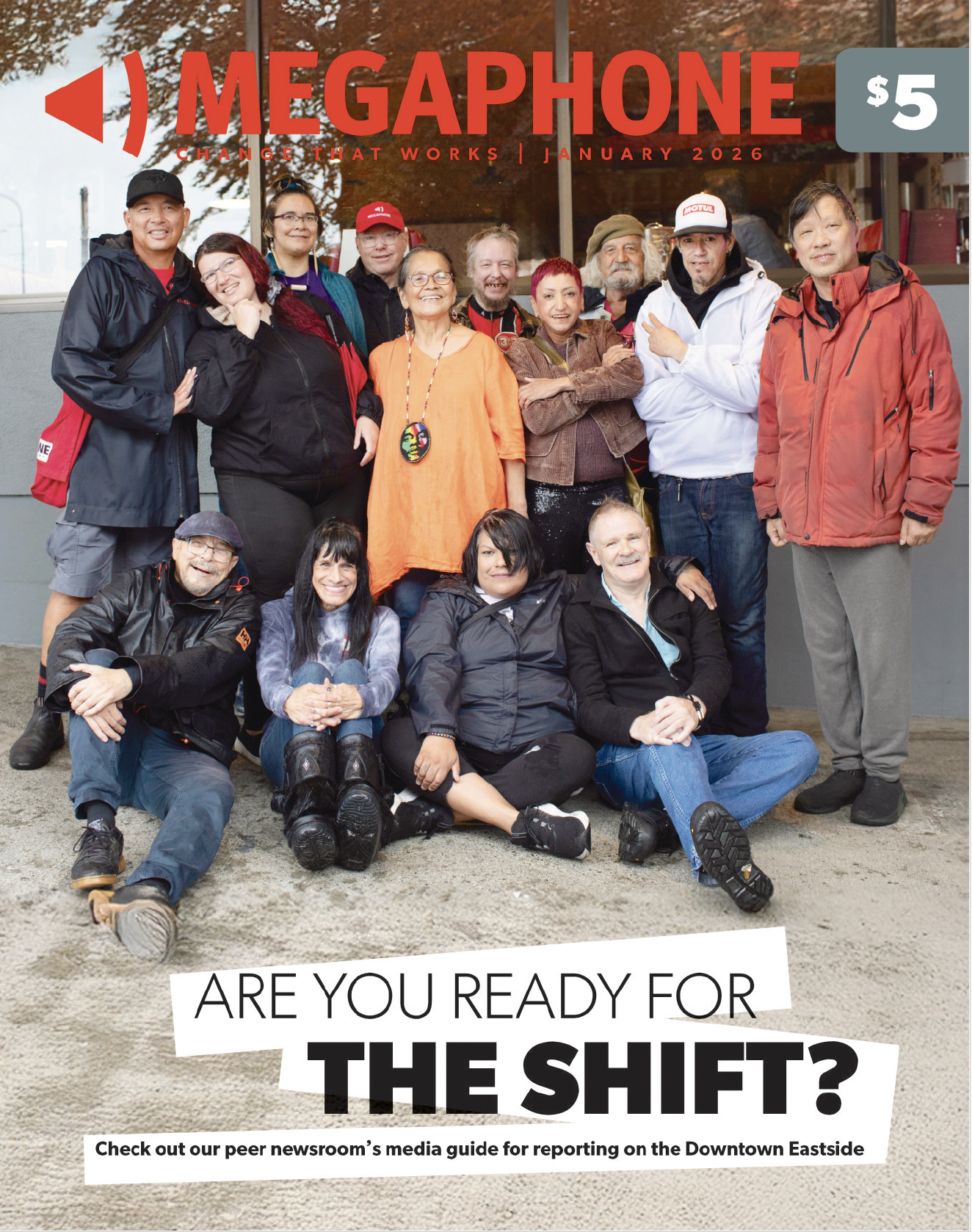
For almost 20 years Judy Graves has been advocating for Vancouver's homeless. Inspiring the homeless counts with her own mini-survey, Graves' advocacy and compassion for people living on the street is unparalleled. As the city's only full-time homelessness advocate prepares to retire next month, Megaphone talks to Graves, the person who knows Vancouver's homelessness issue the best.

Also in this issue: Check Your Head asks you to check your assumptions about youth and activism; John MacInnis questions the motives of anti-gentrification protestors in the DTES; Union Gospel Mission teams up with Elections BC to get low-income people to the voting booth; sex worker advocates ask for leave to president evidence at Supreme Court prostitution case; Megaphone prepares to launch its Voices of the Street literary issue; horoscopes; arts listings; and much more!

Writing Workshop Wednesday: What is fulfillment?, by The Bear Whisperer

Photo by Bigstock.


What is fulfillment?


fulfillment is when you finish having breakfast, lunch, and supper.

fulfillment is when you work a whole day and week and get paid for it.

fulfillment is when you make to love your women and both are satisfied.

fulfillment is when your bills are all paid up.

fulfillment is when you have a good night’s sleep.

fulfillment is when you see the morning sunrise.

fulfillment is when you see the sun set.


The Bear Whisperer participates in Megaphone’s community writing workshop at the Drug Users Resource Centre. This poem also appears in the 2013 edition of Voices of the Street, Megaphone’s annual special literary issue. Voices of the Street will be available from April 19th onward, and sold for $5 by vendors across the city. Find out more about the Voices of the Street launch event at Cafe Deux Soleils on April 19th here, and be sure to get your tickets early here.

Chinese seniors victimized by racism in the Downtown Eastside


So Gee Quan, 65 (left), with her aunt, Jay Gnun Foon, 82. Discrimination is the most difficult issue
faced by Chinese seniors, they say. Photos by Jackie Wong.


It’s lunchtime at the Downtown Eastside Women’s Centre (DEWC). Women of all ages move quickly through a short line near the kitchen, filling plates with salad, thick open-faced sandwiches and a mug of soup. There are about 75 people seated in the dining area, eating lunch and socializing. There are no snaking lineups out the door and around the block here, unlike other agencies that serve free meals to low-income people. And though the place is busy there’s room around the centre’s many circular tables for anyone who wants to sit down. A group of Chinese senior women share one table with younger, English-speaking DEWC members; the two groups communicate by sharing food, gestures and jokes.


Sadly, however, this scene of cheerful harmony between Chinese and English speakers is an exception in the Downtown Eastside. When the 15 Chinese seniors gather in a basement common room to chat with me after lunch, they tell me, unanimously, that discrimination is the biggest issue they face.


“Other people are giving out food to any other race, but when they look at you, they say, ‘Oh, you’re Chinese. You’re from China. Go back to China,’” says 82-year-old Jay Gnun Foon. “They will deny a piece of bread that everybody else is getting. That makes me feel the worst.” But Foon and her 14 friends are strapped for cash after paying for housing, just like others in the area who stand in food lineups. They tell me that that while they don’t always feel welcome in the Downtown Eastside, they deserve to be there as much as anybody else.


Foon has lived in Canada for about 20 years. Her daughter asked her to come to help take care of her children, while she and her husband worked for minimum wage. Now Foon lives alone in old Chinatown, paying $400 a month in rent. She regularly comes to the DEWC to enjoy the company of friends.


Foon and the 14 other women I meet today speak a country dialect of Cantonese that 25-year-old Deanna Wong, the DEWC’s one bilingual Chinese seniors outreach coordinator, translates for me. Wong tells me that most of the women here are from Guangdong Province in China, once farmland but now an industrial region.


“A lot of them come from rural China, and they’ve been farming their entire lives,” she says. When they were coming of age back in the 1930s, ‘40s, and ‘50s, China, as Wong describes it, was “a culture that didn’t support women. Women were treated like objects in Asia, like furniture. Your ownership [went] from your father to your husband.” Many continued to work as farm labourers after coming to the Lower Mainland.


Their health, Wong says, is generally better than that of the roughly 200 other Chinese senior women she works with in the Downtown Eastside. Instead, their most troubling issues are poverty, racism and age discrimination that sometimes find expression in verbal and physical abuse, financial mistreatment and conflicts and miscommunication arising from language barriers.


Wong tells me about Chinese seniors who arrive at the women’s centre with black eyes hidden under sunglasses. Yet few complain, or approach her for help. “They’ll force a smile to cover the pain, and overcompensate for it, to reassure me that things are fine when I know they’re not,” Wong says. “They have my contact information but a lot of times they won’t want to trouble me for it. They’ll try to get it done themselves.”


Wong also makes regular visits to three Downtown Eastside SROs and social housing facilities, where Chinese seniors live among a predominantly English-speaking population. She finds isolation and depression widespread among her contacts.


Her mandate is to connect Chinese seniors with each other and with community supports. Part of her job is to arrange outings for the seniors, designed both for entertainment and the less obvious goal of providing informal opportunities for the women to speak candidly, amongst themselves and with her. She has seen, firsthand, the difference such connections can make in the life of an isolated senior.


“The ones that are healthiest come in the biggest groups,” she says, describing the seniors who regularly show up at the DEWC with their friends. “They don’t have any education. They can’t read. They can’t write. But the way they’re happy, the way they survive, and part of why they’re healthy, is because they have each other.”


Life is much harder for people who have lost touch with their friends. “The ones most isolated are actually the ones who are educated and who are very independent and live alone,” Wong says. “They see all their friends pass away. They become more and more isolated, and they have fewer and fewer activities.”


“We get sworn at for no reason at all”


The close bonds among today’s group of 15 are evident in the way the women laugh together, leaning in to each other’s shoulders. When I first arrive, they are gracious and polite, but reserved. As the afternoon wears on they relax into a funloving rapport. By the end of my visit, So Gee Quan, one of the youngest of the group at 65, has the others in stitches, swearing like a sailor to imitate the people who yell at her as she walks the streets of the Downtown Eastside.


“Fuck, fuck, fuck!” she yells. “We get sworn at for no reason at all. Fuck, fuck, fuck!” Painful as it is, her friends nod their heads and laugh. This is something they’ve experienced, too.


Quan has lived in Canada for 11 years. She worked on a farm in Surrey until the last year, when she could not work anymore. She rents her home in Vancouver’s Hastings Sunrise neighbourhood, paying $700 a month that she splits with her daughter.


“They make it so that it’s not welcoming.” Quan says, with understatement. “It’s very frustrating. They’re bigger than you. Verbal is fine, but sometimes it’s physical. And they can get really aggressive. So you can’t do anything back to them. The only thing you can do is yell back, but that’s about it.”


“My family paid head taxes and we worked until there were holes in our shoes,” she adds. “And we kept working. A lot of my family has been here for generations. And they’re Canadian. And they still face so much discrimination. It’s not fair.”


Quan’s experience validates the findings of a 2007 report to the City of Vancouver by the UBC School of Social Work, that found discrimination and racism, alongside language barriers, were the top concerns among Chinese seniors and service providers in the inner city.


The tension is felt most acutely among the Chinese seniors who must line up with English speakers, similarly struggling to make ends meet, for food and services.


“You’re set up to hate them”


Jason Nepinak has lived in the Downtown Eastside since 1994, homeless for the last 15 of those years. He’s a familiar face at the PHS Drug Users Resource Centre- better known as the Lifeskills Centre-across the street from Oppenheimer Park, where he has volunteered since the centre opened in 2002.


On this rainy morning in February, he’s working the front desk, welcoming people coming in to do laundry, take a shower, get toothbrushes and eat a meal. According to the tally sheets he and other workers maintain, approximately 130 people show up for breakfast here every day. For lunch, it’s closer to 150. The Drug Users Resource Centre is just one of many sources for meals in the neighbourhood. Outside its front doors in Oppenheimer Park, unaffiliated volunteers are off-loading boxes of sandwiches from an unmarked sports utility vehicle. There is already a long line that winds along Powell Street and around the corner to Dunlevy. Most in the line are Chinese seniors.


“You know, it’s a horrible thing to say, but everybody treats ‘em terrible, just terrible,” Nepinak says of elderly Chinese waiting in line. “They say bad things to them. They mock their accents. And it’s just horrible. I hear it a lot, the racial slurs. “


Nepinak, a First Nations man, says he tries to put a stop to any racist activity he sees. “Everybody in the centre knows me,” he says. “They know I don’t put up with violence or racial threats, slurs or anything.”


Some of the hostility, he says, is motivated by faulty assumptions—chiefly that the Chinese seniors are wealthy, and don’t need the food or services as badly as others. But Nepinak’s of a mind that they should be welcome: “Everybody downtown has hard times,” he says.


Coco Culbertson is director of programs with the PHS Community Services Society that runs the Resources Centre. She has lived in Strathcona for 17 years and was the Centre’s first director. She’s seen the number of Chinese seniors who frequent the centre grow in the last 11 years. Now, 15 to 20 Chinese seniors walk through the doors every day. They’re not part of the drug-using population the centre was built to serve. But with few other places to turn, they need the free food and toothbrushes it gives away.


“The programming is targeted to engage active drug users and illicit alcohol drinkers,” Culbertson says. “It is funded to provide resources to those suffering with homelessness, drug addiction and alcohol misuse. We have on occasion had Cantonese-speaking volunteers there, but the language barrier, compounded with the population we serve, makes it difficult for us to fully support the seniors coming in.”


Despite their years in the community, neither Culbertson nor Nepinak could think of resources more suited for Chinese seniors that they could refer people to. Culbertson suggested the Carnegie Community Centre, “but I’m not familiar with what they offer,” she said.


Neither could Gail Harmer, a former social worker, longtime seniors advocate and board member of the 411 Seniors Centre who facilitates seniors wellness workshops with the Council of Senior Citizens’ Organizations of B.C. (COSCO). She could only name the DEWC as the one place where culturally specific programming is available to Chinese seniors.


The Women’s Centre is only a few blocks away from the Drug Users Resource Centre. As is often the case in this neighbourhood, it serves two distinct populations: Chinese-speaking seniors and English-speaking Downtown Eastsiders. Generally both are experiencing poverty, and both are competing for the same limited services.


“When you see those lineups, there’s a limited amount of food,” the DEWC’s Deanna Wong says. “And then when you see a whole group of seniors lined up in the front, you’re set up to hate them because now it’s like they’re taking your food away; this is your means of survival.”


Culbertson agrees. “Everyone feels pressured. And living day-to-day, not knowing if you’ll have food and shelter, doesn’t generally bring out patience for those who are different. The tension is down to poverty.”


More understanding required


What might be accomplished when people are no longer forced to compete against each other is visible every Thursday morning at the Downtown Eastside Neighbourhood House community kitchen.


Taking inspiration from the right to food movement, the Neighbourhood House designs its activities intentionally to eliminate the stigma and indignities of lining up for a charity meal. It prides itself on offering fresh, culturally diverse food choices and welcomes people to join in the preparation in its open kitchen. The Thursday morning community kitchen, designed specifically for Chinese elders, has the effect of breaking down barriers between different language speakers.


“One of the things that we try to do here at the Neighbourhood House is have a range of food so that people from different communities and different cultural groups will see themselves reflected in our menu,” says Executive Director Irene Jaakson. “That’s one of the ways we’ve been able to chip away at some of those barriers. I don’t know that we’ve been 100 per cent successful. But I can tell you that we serve more members of the Chinese community than is typical.”


The DEWC’s Wong shares the view that food brings people together. She has been observing more connection between English- and Chinese-speakers during mealtimes at the Women’s Centre lately. “I’ve noticed at lunchtime, now, the Chinese women will pile together all the bread and salad and leave a [loaded] plate on the centre of the table. They’ll actively seek out other non-Chinese women to take the food,” she says. “I’ve noticed there are a couple of [non-Chinese] women deliberately sitting at those tables, actively trying to get to know them. And it’s really great to see things like that. But that’s only when you can give people food. When you have all those basic needs met.”


It’s a different story when people’s needs are not met. “When you take those away, and people compete for those basic needs, it’s no wonder discrimination happens,” Wong says. “When they look different, you can’t understand them, you can’t talk to them, and you can’t see that you come from so many similar struggles.”


She would like to see more recognition that the two populations in the Downtown Eastside are alike in their vulnerability and their poverty. “Housing is something I see that both populations are in dire, dire need of,” she says. However, she also thinks separate, linguistically appropriate services would particularly benefit Chinese seniors.


In the DEWC basement, the Chinese seniors are packing up to leave, to pick up grandchildren from school or prepare an evening meal for their families. They don’t speak English, but they understand the assumptions some English speakers make about them.


“When people look at us, they think that we look healthy or that we’re well-kept and that we’re not deserving,” says So Gee Quan.


Only in one of Canada’s poorest urban neighbourhoods could an absence of obvious signs of poverty be mistaken for an absence of need—rather than a rare, if fragile, sign of dignity and hope preserved.


This series was produced by Tyee Solutions Society in collaboration with Tides Canada Initiatives Society. This series was made possible through the support of the Real Estate Foundation, Vancity, and BC Non-Profit Housing Association. Support for this project does not necessarily imply Vancity’s endorsement of the findings or contents of this report. TSS funders and Tides Canada Initiatives neither influence nor endorse the particular content of TSS’ reporting. Other publications wishing to publish this story or other Tyee Solutions Society-produced articles, please see TyeeSolutions.org for contacts and information.

Megaphone, Sing Tao Daily and The Tyee collaborated on the publication of this series on Chinese seniors.


MEGA-NEWS: Maple Ridge group needs new home for food program


 Photo by Bigstock.


The St. George’s Anglican Street Ministry in Maple Ridge has yet to find a new home for their weekly free suppers, after being told in January they must move from their current location at the Community Education on Environment Development (CEED) Centre Society building by the end of this month.


The District of Maple Ridge, which owns the land the CEED Centre Society building sits on, told CEED their lease did not cover congregate meals.

A spokesperson for the district told Megaphone they suggested moving the meals because it was becoming too crowded for the residential neighbourhood.


The Street Ministry provides the free meals every Saturday to anyone who is hungry, attracting 50 to 100 people per week and serving everyone from families to single people, people dealing with issues of poverty, homelessness or addictions to just plain hunger.


“I look at it as it’s a potluck dinner with my friends and family,” said Candice Mitchell, who works with the Street Ministry.


“It’s more about a community, making [vulnerable people] feel welcome in their community. They don’t get a lot of opportunities to gather together and feel safe.”


Mitchell says the ministry is considering two different spots—the parking lots of the Maple Ridge Baptist Church and Ridge Meadows Association for Community Living—but so far neither space has been secured.


Christian Cowley, who runs CEED, says district staff are flexible, granting one-week extensions to the supper, which was supposed to have a new place by the end of March.


Mitchell is confident the ministry will find a new place, and they’re already looking at other locations just in case. But if all else fails, she has a back up plan.


“Personally I would go back to doing sandwiches out of my car,” she told Megaphone.

CHOPPED AND STEWED: Got (raw) milk?

Photo by Bigstock.


Milk is a tricky one. Is it strange that we humans consume the byproduct of another mammal’s lactation? Maybe. Regardless, there have been some clever, celebrity-laden and pervasive marketing campaigns (Does a body good and Got Milk?) that have force-fed us the rhetoric that milk is an essential ingredient in growing up strong and healthy.


An interesting juncture in the conversation on milk is where pasteurization meets raw. Pasteurization involves heating, then cooling milk, killing harmful bacteria and lengthening its shelf life. Raw milk is just that, straight from the cow to our bellies.


The Canadian government claims that raw milk is a health hazard and has made it illegal to sell raw milk. It is legal in only certain states in America (Washington being one), but the FDA really doesn’t like it.


Not everyone agrees with the government, though, and proponents of raw milk claim that pasteurization not only kills harmful bacteria, but also good bacteria that helps promote gastrointestinal health as well as enzymes that help bodies absorb calcium (which is what we’re told is the whole point of drinking milk).


To get around the law, people cow share, as in buy shares in a cow. If the cow is partly yours, you can drink its milk all you like, and the farmer hopefully stays out of trouble, too.


Alice Jongerden is a B.C. farmer who set up a large herdshare in Chilliwack, providing raw milk to over 450 families. But in 2010, Jongerden received a permanent injunction to cease providing fresh milk due to “draconian regulation.” Jongerden has responded with a Constitutional Challenge, set to test the validity of the regulation which has caused a total prohibition of fresh milk in B.C. The challenge will be heard July 15, 2013.


The raw milk movement is growing, so much that there was a one-day conference last weekend called “Fresh Milk Food Politics,” that brought together some of the country’s heaviest hitters when it comes to the raw milk debate, including Jongerden.


The raw milk debate is important because one tenant of food security is freedom of choice: choice in knowing from where our food comes and what is really in it, choice in buying locally and from trustworthy growers and farmers if that’s what we want, and freedom to make decisions based on our own research and preferences. Do governments always have our best interest in mind when they make legislation that prevents us from having freedom in our food choices? It will be interesting to see where this debate goes this summer.


Elecia Chrunik is Megaphone's resident food security blogger. For more updates and food-related news, follow her on Twitter @Elecia_C!

< Newer
Older >